
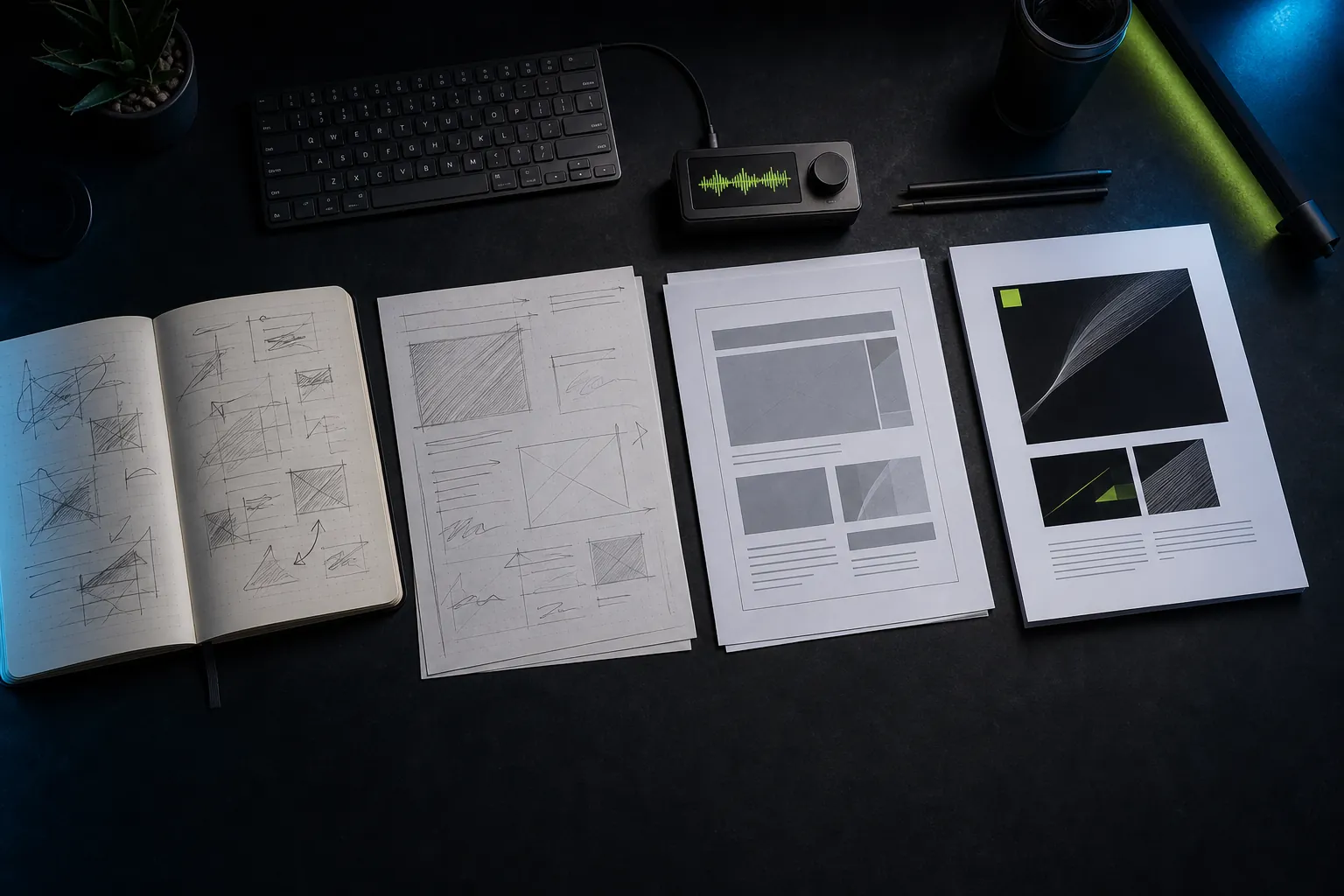
Most content starts in an unfinished form: a sentence spoken aloud, a question that keeps returning, a note with three good fragments, or a half-formed opinion that has not yet found its structure. Treating that material like a finished brief creates generic writing. The useful work is to discover the promise inside the fragment.
Once that promise is clear, the rest becomes a sequence of editorial decisions. Choose the right shape, decide what the reader must understand, make the central idea visible, connect it to what already exists, and preserve the strongest unanswered question for the next page.
§1Find the promise inside the brief
A topic is a label. A promise tells the reader what will become easier after reading. “Agent workflows” is a topic. “Turn a rough spoken request into a page that can be continued by another agent” is a promise.
After reading this page, the reader will be able to [do something useful] without [the common cost, confusion, or failure].
If the sentence cannot be completed plainly, the idea is not ready for a long page. Keep it as a field note until the reader benefit becomes specific.
§2Choose the content shape before drafting
The same idea can become several kinds of page. Pick the shape that matches the reader's job instead of forcing every thought into the same article template.
| Shape | Use it when | The page should leave behind |
|---|---|---|
| Explainer | The reader needs a clear mental model | A definition and a way to recognise the idea |
| Playbook | The reader wants to repeat a sequence | Steps, decision points, and stop conditions |
| Comparison | The real problem is choosing between routes | Trade-offs and a decision rule |
| Field note | One observation changes how the work is done | A sharp lesson and its implication |
| Template | The reader needs a starting artifact | A copy-usable structure with guidance |
Shape controls the outline. A playbook needs sequence. A comparison needs contrast. A field note needs one surprising observation and the decision it changed.
§3Use a content pipeline that creates momentum
The pipeline is not “prompt, draft, publish.” Each stage has one editorial job, and the last stage deliberately feeds the next run.
The six-stage content pipeline
- 01CaptureKeep the raw question or tension.
- 02ShapeChoose explainer, playbook, comparison, note, or template.
- 03MapGive every section one reader job.
- 04DraftWrite the meaning before polishing the surface.
- 05ConnectLink the idea into the existing library.
- 06SeedSave the strongest unanswered question.
§4Give every section one reader job
Before drafting paragraphs, write the question each section must answer. A clean article usually moves through a small set of jobs:
- Orient: what is this, and why does it matter now?
- Differentiate: what does the reader commonly misunderstand?
- Explain: what model, sequence, or comparison makes it clear?
- Apply: what can the reader do with it immediately?
- Extend: where does this connect, and what question follows?
If two sections answer the same question, combine them. If a section has no reader job, cut it. The outline should feel like a line of thought, not a table of contents assembled from keywords.
§5Draft meaning first, surface second
The first pass should protect the idea from premature polish. Write the claim, the sequence, the examples, and the limits in plain language. Only then tighten the headline, shorten the lede, improve transitions, and tune the rhythm.
Pass one asks, “Is the idea complete and useful?” Pass two asks, “Can a reader understand it quickly?” Trying to answer both at once often produces polished paragraphs with no centre.
A strong page can be scanned through headings alone. The body then earns its length by adding reasoning, examples, and nuance—not by restating the heading in slower words.
§6Make the central idea visible
Images and diagrams have different jobs. The image establishes the world of the article: the material, mood, or transformation. The diagram explains a relationship the prose would make harder to hold in working memory.
- Use an image to show setting, progression, contrast, or tangible output.
- Use a diagram to show sequence, hierarchy, branching, ownership, or change over time.
- Use a table when readers need exact side-by-side choices.
- Use a template when the value comes from completing a structure.
Every visual needs a reason to exist, descriptive alternative text or a clear caption, fixed dimensions, and a lightweight format. Decorative filler makes a page slower without making the idea clearer.
§7Connect the page to the library
A published page should not become an island. Link backward to the concept it builds on, sideways to a related method, and forward to the question it creates. That gives the reader a path and gives future pages a place to attach.
For this page, the natural backward links are capturing the original idea by voice and turning working context into a public-safe artifact. The next page can then go deeper on one constraint, visual, or reusable template.
§8Finish by saving the next seed
Do not end a content run by asking for another random topic. Review what the page could not fully answer:
- a term that deserved its own explanation;
- a trade-off that needs a comparison;
- a repeated step that should become a template;
- a visual that reveals a larger model;
- an objection that would make a useful field note.
Choose one seed that connects naturally to the library, give it a reader promise and visual brief, then place it in the queue. The loop grows by following useful questions, not by publishing for the sake of activity.
§9A copy-usable content brief
brief one complete page
READER PROMISE
After reading, the reader can [useful outcome] without [common cost].

CONTENT SHAPE
Explainer | playbook | comparison | field note | template

SECTION JOBS
Orient → differentiate → explain → apply → extend

NARRATIVE IMAGE
Show the setting, transformation, or tangible result. No filler.

DIAGRAM
Show the sequence, hierarchy, comparison, or decision the prose cannot.

LIBRARY LINKS
One idea this builds on; one related idea; one question that follows.

NEXT SEED
The strongest useful question this page leaves unanswered.
Steal this
- Turn the topic into a specific reader promise before drafting.
- Choose the content shape that matches the reader's job.
- Give every section one question to answer.
- Draft the meaning before polishing the surface.
- Use one narrative image and one explanatory visual with distinct jobs.
- Connect every page backward, sideways, and forward.
- End with one strong seed for the next useful page.