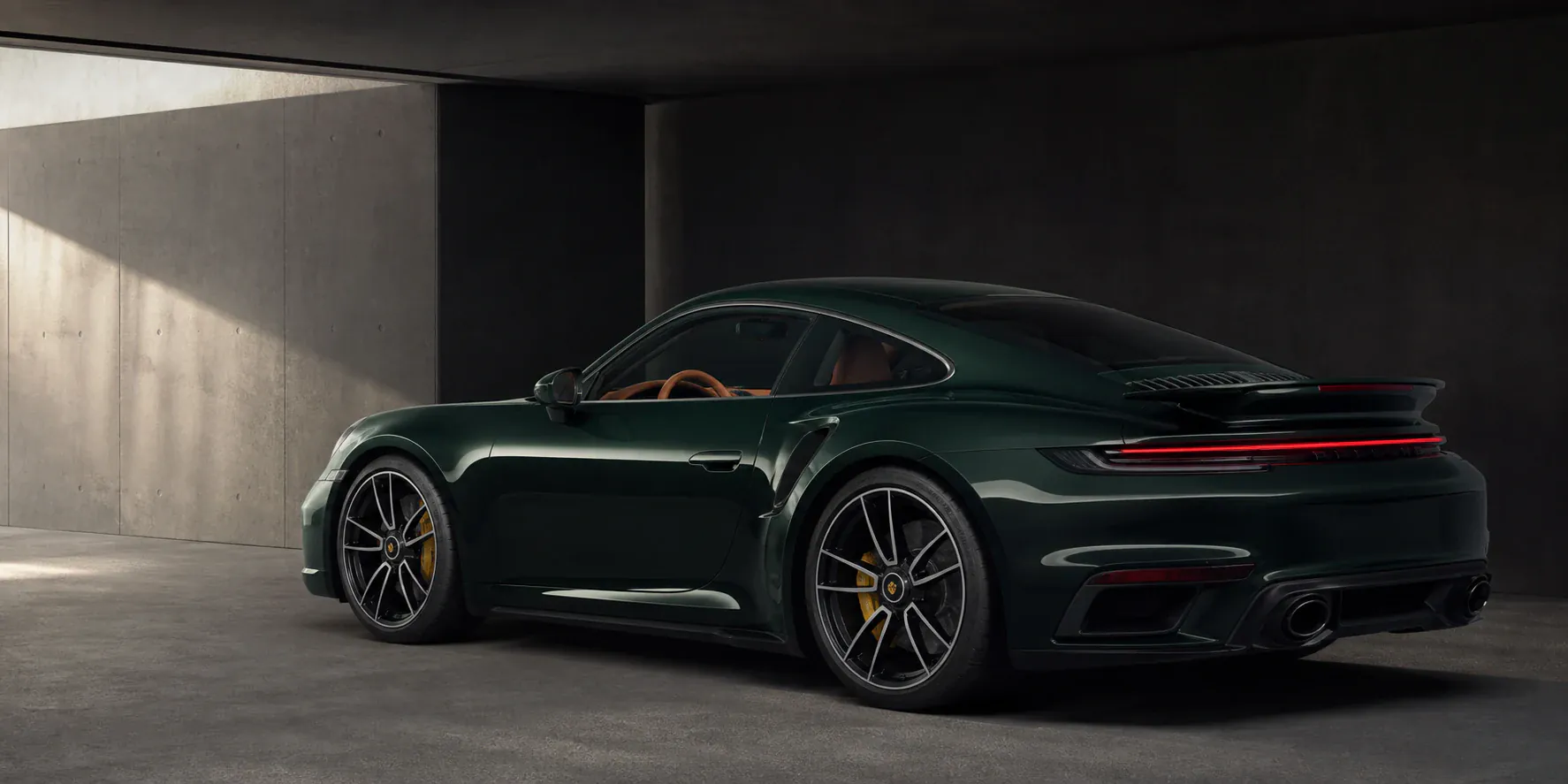
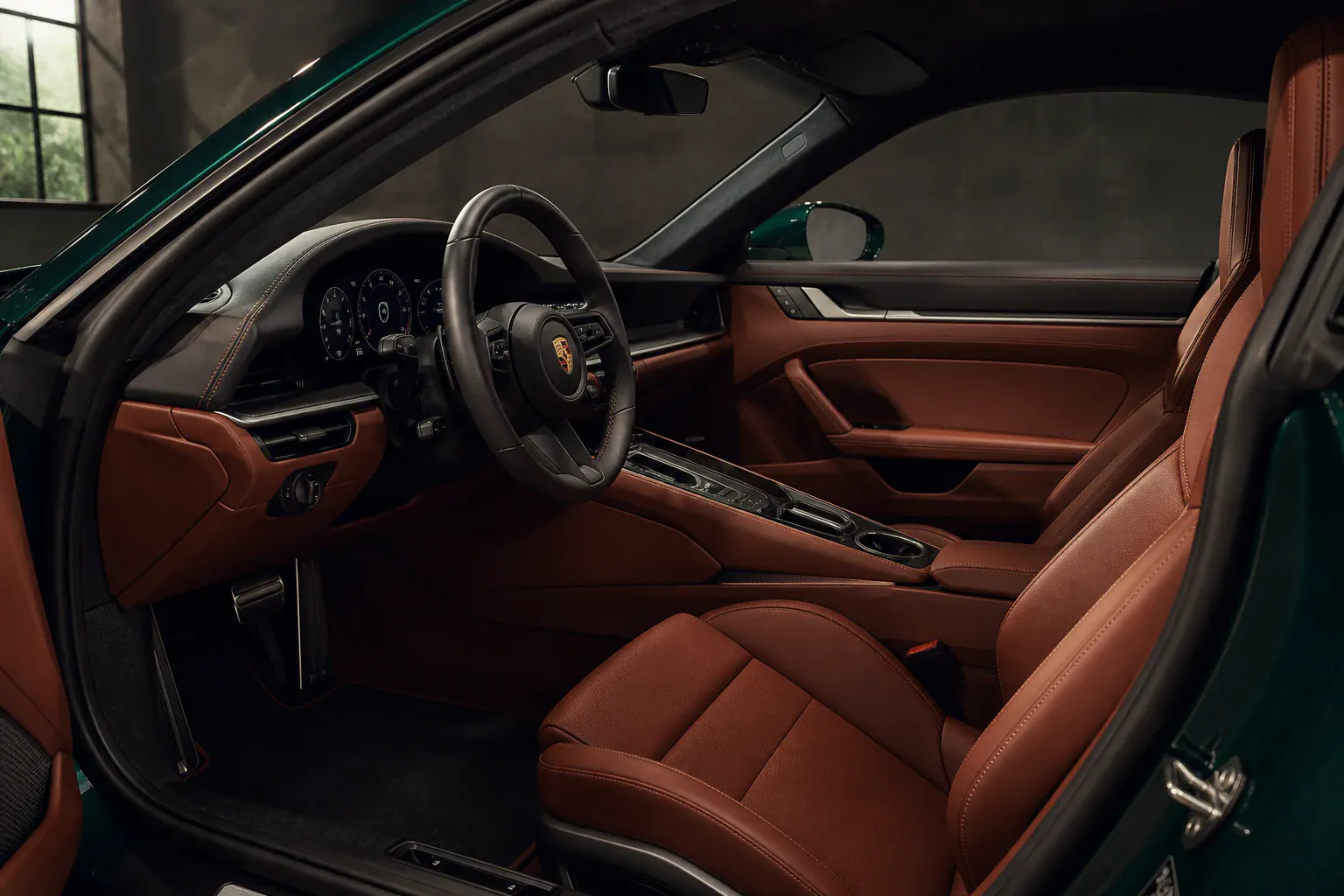
The images on this first entry are editorial configuration studies, not delivery photographs. I will add the real car, fitment, and road notes as the build progresses.
01 / THE COMMISSION
A restrained specification with one warm interruption.
I wanted a Turbo S that reveals itself slowly. British Racing Green reads formal from a distance and comes alive only when light catches the body. Terracotta changes the temperature as soon as the door opens. The two-tone treatment keeps that warmth deliberate rather than overwhelming.
02 / COLOUR
Dark green outside. Terracotta within.
Porsche describes British Racing Green as a rich, deep shade associated with speed, performance, and luxury, and lists it within the marque’s Paint to Sample catalogue. That history matters, but the appeal here is simpler: it gives the Turbo body presence without making the car shout.
Inside, Terracotta supplies the emotion the exterior withholds. Against a dark upper cabin, it should make the interior feel tailored and architectural—warm enough to be memorable, controlled enough to live with every day.
MOTION STUDIES / TWO NIGHTS
The same green, after rain.
Two short films I directed with AI video tools: Downtown Dubai, then a neon New York. They are studies of how the colour behaves in moving light, not footage of the delivered car. The number plate is blurred.
AI-GENERATED · HIGGSFIELD · PLATE BLURRED · How I direct AI video →
03 / THE NEW TURBO S
The first Turbo S of the T-Hybrid era.
The colour is heritage-led; the powertrain is not. Porsche’s new 992.2 Turbo S combines a 3.6-litre flat-six with its 400-volt T-Hybrid system and two electric exhaust-gas turbochargers. It is a technical change large enough to make this generation feel like a real new chapter rather than a cosmetic revision.
- 711
- PS system output
- 800
- Nm maximum torque
- 2.5
- seconds · 0–100 km/h
- 322
- km/h top speed
Porsche publishes 523 kW (711 PS), 800 Nm, a 2.5-second sprint to 100 km/h, and a 322 km/h top speed for the Coupé. Those numbers describe the scale of the platform; they are not my driving review. That begins only after time in the actual car.
The factory car already receives a titanium sports exhaust that Porsche says removes 6.8 kg. The JCR order is therefore not about correcting a weak starting point. It is about changing material, flow, and character while keeping the finished build visually disciplined.
04 / ORDERED HARDWARE
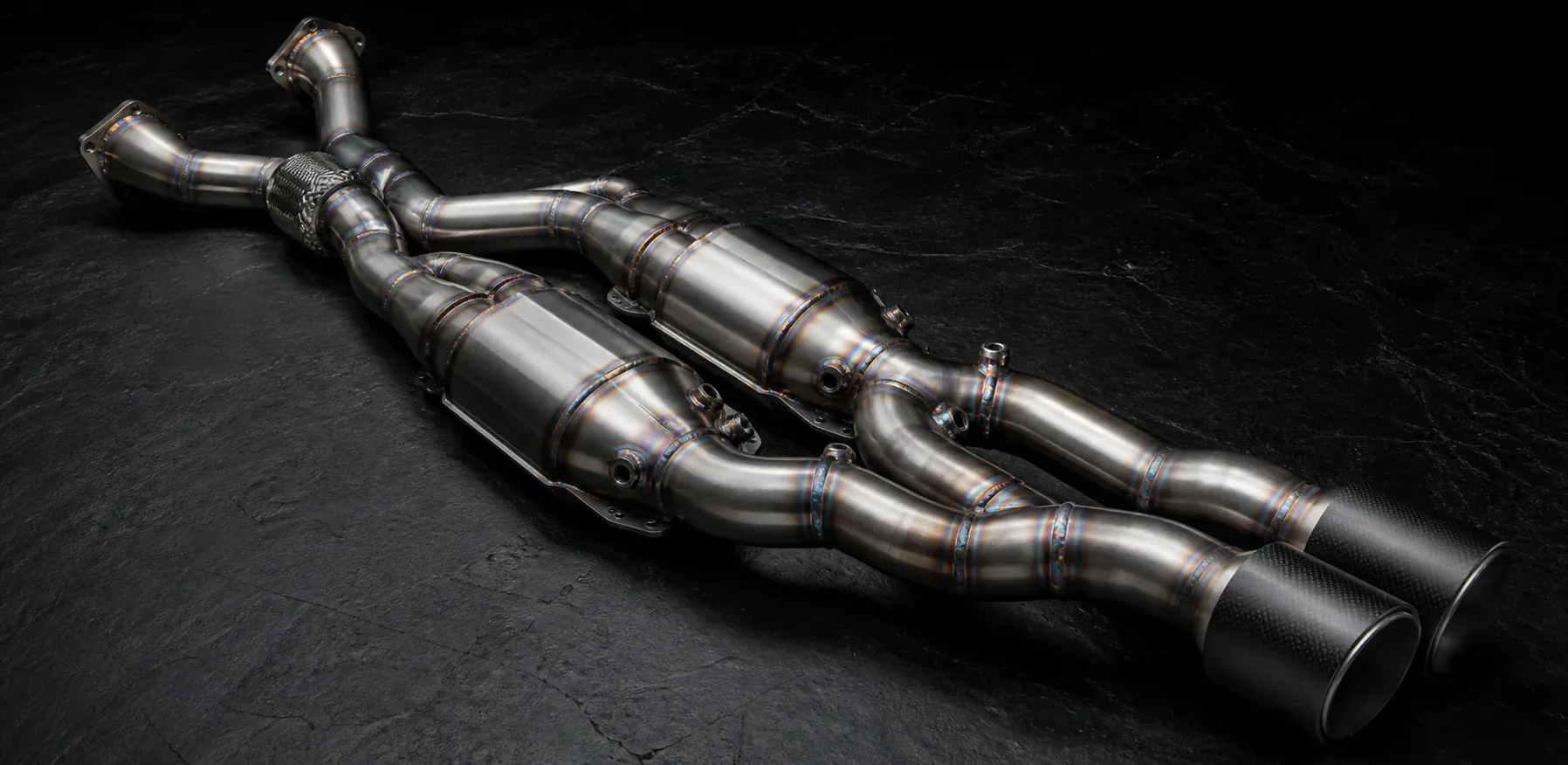
JCR exhaust with race cats, now on order.
I have ordered JCR’s 992.2 Turbo S exhaust in the race-cat configuration. The attraction is the complete approach: lightweight alloys, retained factory valve operation, and a system developed specifically around the new T-Hybrid Turbo S architecture.
JCR lists Inconel 625 race-cat and side-silencer sections with a titanium centre section.
The race-cat version uses two HJS 200-cell catalysts in place of the original catalyst and particulate-filter arrangement.
JCR says the package retains the factory valve function without a separate controller or coding.
JCR publishes a 21.84 kg reduction versus the OEM system for this configuration. That is a maker claim, not yet measured on my car.
Compatibility with local road-use, emissions, registration, installer, and warranty requirements will be checked before installation. Sound, fit, warning-light behaviour, weight, and driving impressions will be documented only after the finished car has been inspected and driven.
SOURCE / JCR 992.2 Turbo S race-cat system ↗ · 992.2 exhaust programme ↗
05 / WHAT COMES NEXT
A build journal, one entry at a time.
- 01Arrival and inspection
Real exterior and interior photography, specification details, and first impressions.
- 02JCR installation
Part identification, fitment quality, measured weights, and the checks completed before road use.
- 03Sound with context
Cold start, warm idle, valve positions, and cabin behaviour—recorded consistently, without phone-microphone theatre.
- 04Living with it
Notes after real distance: ride, response, heat, noise, usability, and what I would choose again.
“The aim is not the loudest Turbo S. It is a specification that feels coherent from paint to pipework.”